No Continuous Working Load in School Timetable Software
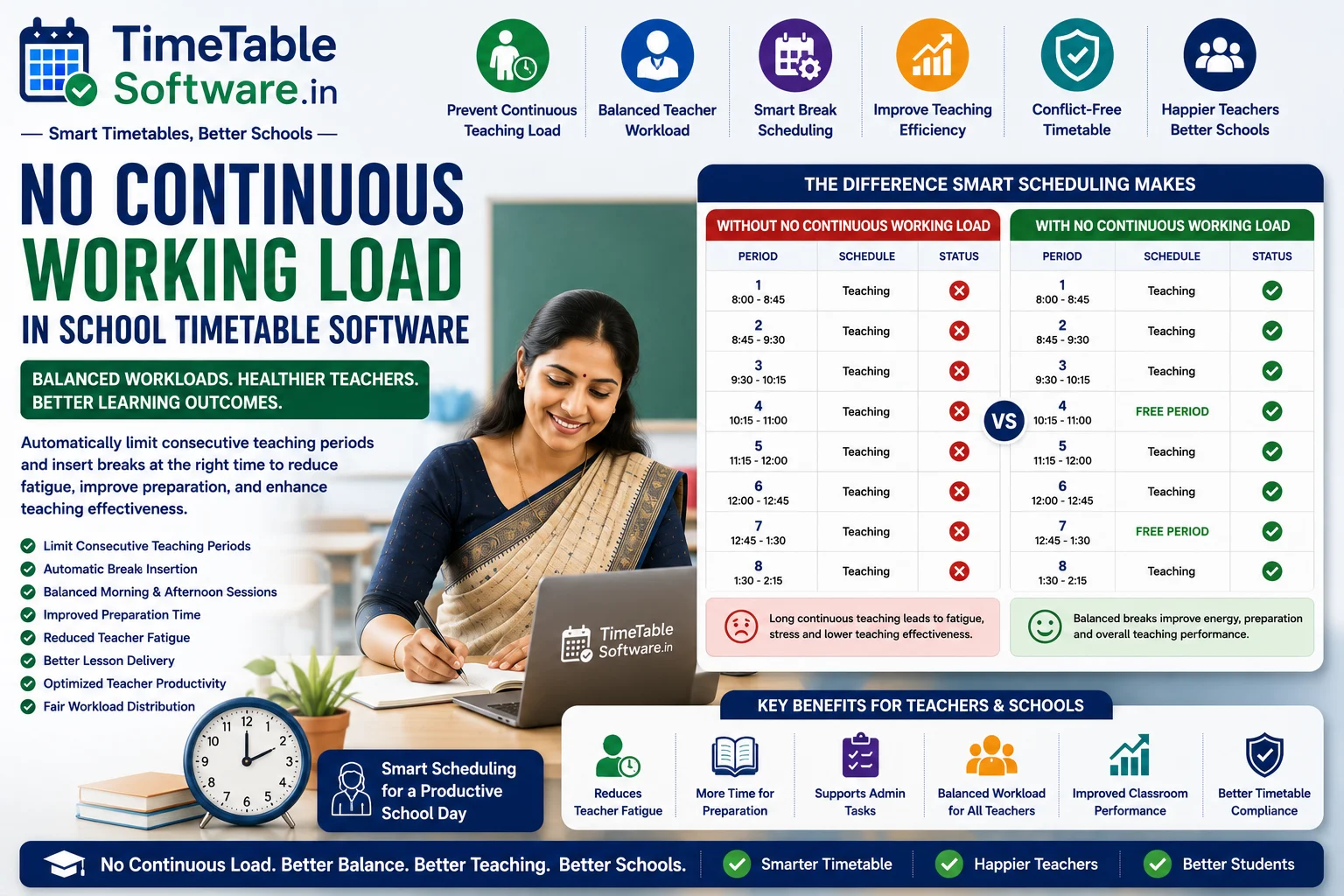
Teachers require sufficient breaks throughout the school day to prepare lessons, evaluate assignments, counsel students, and perform administrative duties. Continuous teaching without adequate free periods leads to fatigue, reduced classroom effectiveness, and lower productivity. The No Continuous Working Load feature intelligently limits consecutive teaching periods by inserting free periods wherever possible while respecting teacher availability, subject allocation, laboratory scheduling, workload limits, and all other timetable rules to create healthier, balanced, and conflict-free teacher schedules.
What is No Continuous Working Load?
No Continuous Working Load is an intelligent scheduling rule that limits the number of consecutive teaching periods assigned to teachers. Schools can configure workload policies such as maximum consecutive teaching periods and mandatory breaks, and the timetable engine automatically enforces these rules while generating conflict-free timetables.
Why Schools Need No Continuous Working Load
Reduced Teacher Fatigue
Regular breaks between teaching sessions help teachers maintain energy, focus, and classroom effectiveness throughout the day.
Better Lesson Preparation
Teachers receive adequate preparation time between classes to improve instructional quality and classroom engagement.
Administrative Efficiency
Free periods provide time for attendance, assessments, counselling, record maintenance, and parent communication.
Balanced Teacher Workload
Ensures teaching responsibilities are distributed fairly while preventing excessive consecutive teaching assignments.
Challenges of Manual Workload Scheduling
Common No Continuous Working Load Rules
Maximum Consecutive Teaching Periods
Limit teachers to a configurable number of continuous teaching periods such as two, three, or four classes.
Automatic Break Allocation
Insert free periods automatically after the maximum teaching limit is reached whenever possible.
Morning & Afternoon Balance
Prevent teachers from teaching continuously throughout either the morning or afternoon session.
Department-Specific Policies
Allow different workload limits for departments, senior staff, coordinators, or specialized teachers.
Key Features of No Continuous Working Load
Benefits of Balanced Teacher Workloads
Reduced Teacher Fatigue
Teachers receive regular breaks that improve concentration, energy levels, and classroom performance.
Improved Teaching Quality
Balanced workloads allow teachers to deliver more engaging and effective lessons throughout the day.
Better Lesson Preparation
Scheduled breaks provide valuable preparation time for upcoming classes and learning activities.
Better Student Experience
Students benefit from well-prepared, focused, and energetic teachers during every class.
Administrative Productivity
Teachers gain dedicated time for assessments, attendance, counselling, and academic administration.
Higher Teacher Satisfaction
Fair workload distribution improves morale, reduces stress, and supports teacher well-being.
Faster Timetable Generation
The timetable engine automatically applies workload balancing rules during timetable generation.
Ideal For
Why Schools Choose TimeTableSoftware.in
Maximum Consecutive Period Limits
Automatically limits continuous teaching periods according to institution-defined workload policies.
Automatic Break Allocation
Inserts teacher free periods intelligently to reduce fatigue while maintaining academic continuity.
Teacher Workload Optimization
Balances teaching responsibilities throughout the day while respecting workload limits and teacher availability.
Equal Free Period Distribution
Works together with free period balancing rules to distribute teacher breaks fairly across both sessions.
Department-Wise Scheduling
Supports customized workload policies for departments, coordinators, principals, and specialized teachers.
Teacher Preference Support
Allows schools to configure individual workload limits and scheduling preferences for selected teachers.
Conflict Detection
Validates teacher availability, classroom allocation, laboratory scheduling, workload limits, subject distribution, and all timetable constraints before finalizing schedules.
Manual Override
Allows administrators to modify automatically generated workloads whenever operational requirements change.
Real-Time Timetable Optimization
Continuously maintains balanced teacher workloads while adapting to timetable updates and institutional requirements.
Common Questions
Everything you need to know about this timetable feature.
What is No Continuous Working Load?+
No Continuous Working Load is a scheduling feature that limits consecutive teaching periods assigned to teachers, ensuring regular breaks while respecting all timetable constraints.
Why is limiting continuous teaching important?+
Limiting continuous teaching reduces teacher fatigue, improves lesson preparation, supports administrative work, and helps teachers maintain high classroom performance throughout the day.
Can schools define the maximum number of consecutive teaching periods?+
Yes. Schools can configure their own workload policies such as a maximum of two, three, or four consecutive teaching periods based on institutional requirements.
Does the software automatically insert teacher breaks?+
Yes. Whenever possible, the timetable engine automatically inserts free periods while maintaining subject allocation, teacher availability, and all scheduling rules.
Can different teachers have different workload limits?+
Yes. Schools can configure department-specific and teacher-specific workload policies for senior staff, coordinators, external teachers, or part-time faculty.
Will this affect subject allocation?+
No. The software continues to satisfy curriculum requirements while balancing teacher workloads, laboratory scheduling, classroom allocation, and all other timetable constraints.
Can administrators manually modify workloads?+
Yes. Manual Override allows authorized users to adjust teacher workloads whenever necessary while every modification is validated to prevent timetable conflicts.
Is this feature suitable for all school boards?+
Yes. It supports CBSE, ICSE, State Board, Government, Government Aided, Matriculation, Higher Secondary, International Schools, Residential Schools, Colleges, and Polytechnic Institutions.
Can No Continuous Working Load work with other timetable rules?+
Yes. It integrates with Teacher Availability, No Gaps Rule, Equal Distribution of Working Periods, Free Period Equal Distribution, Fixed Practical Periods, Double Period Scheduling, and other scheduling constraints.
How does No Continuous Working Load improve school operations?+
It creates balanced teacher schedules, reduces fatigue, improves classroom effectiveness, supports administrative work, simplifies timetable preparation, and enhances overall academic efficiency.
Final Thoughts
No Continuous Working Load is an essential feature of modern School Timetable Software. By automatically limiting consecutive teaching periods, intelligently inserting teacher breaks, balancing workloads, and validating every timetable constraint, schools can create healthier teacher schedules, improve instructional quality, and generate conflict-free timetables that enhance both teacher well-being and student learning outcomes.
Continue Reading
Explore more guides about school timetable software features.
Teacher Availability Management in School Timetable Software | Complete Guide
Learn how teacher availability management helps schools generate conflict-free timetables while respecting teacher schedules.
Part-Time Teacher Management in School Timetable Software | Complete Guide
Manage part-time teachers efficiently using timetable software with subject and availability constraints.
Combined Subject Scheduling in School Timetable Software: A Complete Guide for Indian Schools
Understand combined subject scheduling and how timetable software automates it.
Combined Teacher Scheduling in School Timetable Software: Complete Guide for Indian Schools
Learn how combined teacher scheduling works in automated timetable software.
Combined Class Scheduling in School Timetable Software: Complete Guide for Indian Schools
Learn how combined classes are managed in modern timetable software.
Laboratory Allocation in School Timetable Software: Complete Guide for Indian Schools
Efficient laboratory allocation for Physics, Chemistry, Biology and Computer labs.
Double Period Scheduling in School Timetable Software: Complete Guide for Indian Schools
Automatically schedule double periods without conflicts.
Subject Distribution in School Timetable Software: Complete Guide for Indian Schools
Balanced subject distribution across the week using AI timetable generation.
No Gaps Rule in School Timetable Software: Complete Guide for Indian Schools
Generate timetables with no unnecessary gaps for teachers.
Conflict Detection Engine in School Timetable Software: Complete Guide for Indian Schools
Prevent teacher, classroom and laboratory conflicts automatically.
Manual Override in School Timetable Software: Complete Guide for Indian Schools
Modify generated timetables manually while maintaining consistency.
Automatic Substitute Teacher Scheduling in School Timetable Software: Complete Guide for Indian Schools
Automate substitute teacher allocation instantly.
Class Teacher Uniform Period in School Timetable Software: Complete Guide for Indian Schools
Allocate common periods for class teachers efficiently.
Principal / Vice Principal Uniform Free Periods in School Timetable Software: Complete Guide for Indian Schools
Reserve uniform free periods for school administration.
Conditional P.T. Periods in School Timetable Software: Complete Guide for Indian Schools
Configure PT periods using advanced timetable rules.
Equal Distribution of Working Periods in Both Sessions: Complete Guide for School Timetable Software
Balance teacher workload across morning and afternoon sessions.
Fixed Practical Periods in School Timetable Software: Complete Guide for Indian Schools
Schedule practical sessions at fixed periods automatically.
External Teacher Periods in School Timetable Software: Complete Guide for Indian Schools
Manage visiting and external teachers efficiently.
Free Period Equal Distribution in Both Sessions: Complete Guide for School Timetable Software
Distribute teacher free periods equally throughout the day.
Timetable Reports in School Timetable Software: Complete Guide for Indian Schools
Generate printable teacher, class and school timetable reports.